Category: Tips and Tricks

Master your retirement! Get expert tips, hacks, and strategies for a healthy and fulfilling retirement life. I have a lot of useful guides waiting for you!

  • What Retirees Do All Day: Top Activities for a Meaningful and Active Retirement

    What Retirees Do All Day: Top Activities for a Meaningful and Active Retirement

    Planning for a fulfilling retirement is a crucial step in securing financial security and overall well-being. However, navigating this new chapter can raise questions about how best to utilize newfound free time. So, what do you need to do to answer this question? Well, look at the data and see how other seniors and retirees are doing with their time.

    So, this article explores how retirees typically spend their days, drawing on data from the American Time Use Survey by the Bureau of Labor Statistics (BLS). We will delve into the most popular activities among retirees, highlighting the importance of staying active and engaged for a happy and healthy retirement.

    Popular And Common Retirement Activities According To BLS

    Your upcoming retirement is likely something you’re both looking forward to and apprehensive about. Many people initially struggle with how to fill their days. However, knowing what other retirees do can be reassuring.

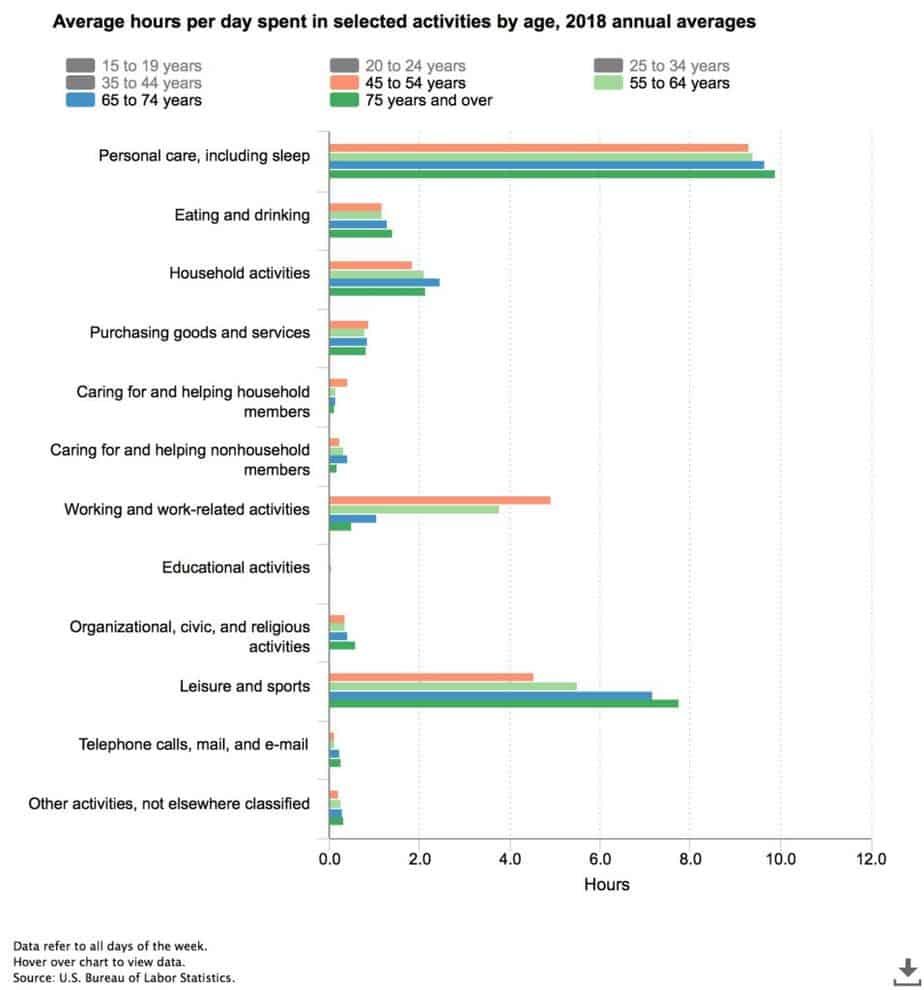
    The American Time Use Survey by the BLS offers valuable insights. Most retirees spend their days engaged in normal activities like sports, socializing, traveling, and personal care (including sleep). According to the survey, people between 65 and 75 years old and over dedicate an average of over nine hours a day to personal care activities. Leisure and sports activities occupy another seven or more hours.

    Household chores (around two hours daily) and eating/drinking (approximately one and a half hours daily) are also common time commitments. Interestingly, the survey reveals that work-related activities decrease as people age. When comparing the 45โ€“64 and 65+ age groups, the most significant change is in work-related activities, which is logical due to retirement.

    Below is a snapshot of the American Time Use Survey chart from BLS:
    You can see the full article on the website of BLS

    The chart initially surprised me with its low numbers for educational activities among retirees. However, it’s important to clarify that this category likely refers to formal schooling or college courses.

    In reality, activities like reading (which can be highly educational) or taking online courses fall under ‘leisure activities’ in the survey. Regardless of the label, staying active mentally is crucial for healthy aging.  When you keep learning, you keep your brain sharp and contribute to mental fitness. We’ll explore this further later.

    The listed activities in the survey are too broad, so Iโ€™m going to break them down in the next section.

    A Breakdown Of Popular And Common Activities In Retirement

    Popular activities in retirement can be categorized in several ways. One approach focuses on physical, mental, and social aspects. Another breaks them down into basic needs, leisure, and health maintenance.

    This article will explore these categories and provide tips for incorporating them into your lifestyle, even if you haven’t already.

    Physical Activities

    Staying active is key for retirees to thrive. Regular exercise isn’t just about maintaining a healthy weight or warding off chronic diseases like heart trouble and diabetes. It’s a powerful tool to boost energy levels, improve mood, and enhance overall well-being.

    Think about daily walks in nature or group exercise classes designed specifically for retirees. The Centers for Disease Control and Prevention (CDC) recommends at least 150 minutes of moderate-intensity aerobic activity each week for adults over 65, along with muscle-strengthening exercises two or more days a week.

    Incorporating physical activity doesn’t have to be complicated. Schedule those walks, join a local fitness class, or explore low-impact options like swimming or yoga. To push yourself further, set specific fitness goals, track your progress, and gradually increase the intensity or duration of your workouts.

    Read my article, How Can You Stay Active in Retirement, for more ideas. Meanwhile, let me talk about two of the most common physical activities my retiree friends often do.

    Walking

    Walking is a very popular and common activity for retirees. It’s a great way to boost your health and happiness in several ways.

    First, walking with others is a fun way to make new friends. You’ll meet people who enjoy being active and exploring new places, just like you. Plus, having company can make your walks more enjoyable.

    Second, walking regularly helps you stay active, which is important for your overall health. It keeps your body moving and your muscles strong.

    Finally, walking can improve your mood and make you feel more positive. It’s a great way to get some fresh air and sunshine, which can boost your spirits.

    By the way, a study by Korean researchers suggests that walking faster might give you even more benefits. But remember, the most important thing is to get out there and start walking, no matter your pace. Walking is a simple activity with big rewards for your health and happiness in retirement!

    Swimming

    Swimming is a popular choice for retirees seeking a refreshing, social, and low-impact exercise option. Local pools and aquatic centers offer opportunities for physical activity, relaxation, and socializing with peers.

    Social swimming activities can take various forms, including water aerobics classes, joining a master’s swim club, or simply organizing group swims with friends.

    A study published in the International Journal of Aquatic Research and Education explored the health benefits of swimming. Their findings suggest that swimming is an effective way to improve cardiovascular fitness (CRF) for both healthy individuals and those with chronic diseases.

    The study highlights the various health advantages of swimming, positioning it as a valuable alternative to other forms of exercise. Interestingly, the results indicate that swimming might be just as beneficial as running, and potentially more advantageous than walking or inactivity altogether.

    Mental Activities

    Just like physical exercise keeps your body strong, mental stimulation helps your brain stay sharp. Reading, puzzles, and games aren’t just funโ€”they can actually enhance your memory, problem-solving skills, and overall cognitive function. Studies even suggest mental activities might help ward off cognitive impairment and decline.

    Think beyond crossword puzzles (though those are great too!). Imagine lively book clubs, fascinating lectures, or even learning a new language. Spark your curiosity and social connections by joining discussion groups or taking up a mentally stimulating hobby like painting or photography.

    There are many ways of staying mentally active. To get some ideas, check out my article: How Do I Keep My Brain Active In Retirement. Meanwhile, continue reading to know some mental activities I wholly recommend. 

    Take A Class

    A mental activity I love personally is taking classes. Taking a class isn’t just about acquiring new skillsโ€”it’s also a social adventure with a sprinkle of personal growth. Imagine whipping up culinary masterpieces in a cooking workshop, capturing stunning photos in a photography class, or letting your creativity flow in an art session.

    The benefits are more than just bragging rights, although those are fun too! According to Knute Nelson, a non-profit organization serving seniors, continued learning may help older adults increase neuron generation, reduce dementia risks, and improve their ability to handle challenges.

    Community colleges, adult education programs, and online platforms offer a treasure trove of options. Look for courses that ignite your curiosity, whether it’s mastering a new language, delving into history, or finally learning that instrument you always dreamed of playing.

    When you get yourself enrolled, don’t just be a passive participant! Dive headfirst into discussions, collaborate with classmates, and find ways to apply your newfound knowledge. Maybe you’ll bake a gourmet cake from your cooking class for a family gathering or showcase your photography skills with a local exhibit.

    For an extra dose of inspiration, consider MasterClass. This unique platform lets you learn from the best in the field. Follow a tennis clinic from Serena Williams, a cooking class by Gordon Ramsey, or a comedy class by Steve Martin! Learning a new skill has never been easier or more engaging.

    Meditation 

    Meditation, a form of mindfulness practice, offers a valuable tool for retirees seeking to manage stress and cultivate inner peace. It provides a structured approach to emotional regulation, promoting a sense of calm and well-being.

    While research on the full range of physical and mental health benefits for seniors is ongoing, studies consistently show that mindfulness activities like meditation are enjoyable and well-tolerated by older adults. This enjoyment itself can be a significant factor in promoting continued engagement with the practice.

    Integrating meditation into a daily routine is easier than you might think! Many applications and online resources offer guided meditations, perfect for beginners. These short sessions can help you develop comfort and familiarity with the practice.

    As you become more comfortable with meditation, consider exploring various techniques. Popular options include mindfulness meditation, loving-kindness meditation, and body scan meditation. Each technique offers a unique approach, so finding the one that resonates most with you is key to sustained practice.

    Social Activities

    Social connection is the cornerstone of a happy and healthy retirement. Retirees understand this well, actively seeking out opportunities to connect with others. After all, social activities can push someone to become more active and offer a powerful antidote to loneliness, fostering a sense of belonging and purpose.

    Imagine nurturing your passion for gardening with a local club, tackling challenging hikes with a group of fellow enthusiasts, or delving into new worlds with a vibrant book club. These activities provide much more than shared experiences. They offer companionship, support, and meaningful interactions that enrich your life.

    The benefits extend beyond the immediate joy of social connection. A study on social engagement patterns in underprivileged communities across six countries suggests that social activity promotes healthy living. Researchers found a link between social engagement and healthier habits like exercise and sleep, as well as lower levels of sadness and ill health.

    Make social connection a priority in your retirement. To get started, look for like-minded people you can connect with.  Being part of a group is a two-way street, so focus on building genuine connections and offering your own time and talents as well as benefiting from theirs. Take the initiative by hosting gatherings at your place, and be sure to attend theirs as well. This reciprocity will help you build strong friendships within the group.

    And, just like before, let me tell you two (technically three) important social activities you can get started with. If youโ€™re done with this article, be sure to remind yourself to visit my article, 20 Ways How To Stay Social After Retirement, to gain more insights regarding social activities.

    Joining Clubs And Befriending Neighbors

    Joining a club can be a game-changer for retirees seeking social connections and shared interests. It’s a fantastic way to build meaningful relationships with like-minded individuals who share your passion for gardening, sports, volunteering, or any other hobby.

    However, the benefits of social connection extend beyond formal clubs. Professor Alex Haslam from the University of Queensland’s School of Psychology suggests that simply feeling a sense of belonging to your neighborhood can be very good for your mental health.

    Think about it: striking up conversations with neighbors, participating in community events, or even just feeling a sense of camaraderie with those around you can contribute to overall well-being.

    So, while clubs offer a structured way to connect, don’t underestimate the power of fostering a strong neighborhood identity. It’s all about finding ways to connect with the people around you and build a sense of belonging.

    Traveling

    For retirees, travel transforms from checking destinations off a list to creating lasting memories and forging deeper social connections. Imagine embarking on a group tour, where you’ll explore new cultures and share adventures with fellow travelers. Or perhaps you envision a multi-generational family trip, fostering closer bonds with loved ones while experiencing the world together.

    According to Chinese researchers, the very essence of tourism fuels various social benefits. Whether it’s fellow travelers on a tour, knowledgeable guides, or friendly locals encountered along the way, these interactions contribute significantly to your well-being.

    Think about it: these encounters provide opportunities for connection, companionship, and emotional support. You might learn new perspectives from fellow adventurers, gain insights from experienced guides, or simply share a laugh with local shopkeepers.

    When it comes to traveling and tourism, there are countless ways to get started! Join a travel club and connect with like-minded adventurers. Participate in group travel experiences tailored specifically for retirees. Or, plan a trip with friends or family, creating lasting memories together.

    However, be reminded that having a great travel adventure doesn’t mean that you need to go to a different country. Thereโ€™s also a lot to explore in the United States. You can check out my article 20 Best Retirement Trips In The USA for more inspiration. 

    Get the #1 Retirement EBook
    and find happiness in retirement in just 5 steps!
    Conclusion

    After reading this article, you likely now have a good idea of what retirees typically do each day. The article also highlighted the benefits of these activities and how you can integrate them into your daily life as a retiree.

    To learn more about the life of a retiree and the things you need to know, be sure to check out my other articles, such as these:

    Happy reading!
  • 13 Critical Aspects You Need To Know Before Retiring: A Short Guide

    13 Critical Aspects You Need To Know Before Retiring: A Short Guide


    Preparing for retirement is important because it makes transitioning smoother. This article contains essential information to assist you in getting ready for retirement. Let’s begin!

    1. Keeping Socially Engaged

    Staying active and maintaining social relationships are crucial aspects of healthy aging and retirement. Social interactions not only help us stay mentally sharp, but they can also contribute to physical well-being. However, decreased social engagement as we age can be a significant risk factor for our health.

    The benefits of a strong social life are numerous. Having strong social connections can significantly reduce the risk of depression. Additionally, increased social interaction is associated with higher physical activity levels, creating a positive feedback loop for overall health.

    In essence, social interactions are just as vital for healthy aging as well-established health practices like not smoking and eating a balanced diet. Social engagement acts as a mental stimulant, fostering cognitive function and memory.

    Read: How To Stay Social After Retirement

    2. Staying Mentally Healthy

    A happy retirement hinges on prioritizing both mental health. By staying active in mind, you significantly increase your chances of healthy aging. Mental agility is key, and there are numerous ways to keep your mind sharp.

    Engaging in activities like solving puzzles or reading books can provide a mental workout. Additionally, maintaining an open mind and continuously learning new things are excellent ways to stay mentally stimulated. Learning not only stimulates the brain but can also lead to a sense of fulfillment. Consider taking a class, which can offer the dual benefit of social interaction and a sense of accomplishment. Remember, the pursuit of knowledge has no age limit!

    For those looking for structured learning opportunities in retirement, an annual membership to Masterclass is a fantastic option. With courses taught by renowned figures like Gordon Ramsey, Christina Aguilera, and Usher, Masterclass offers a vast selection on nearly any subject imaginable, catering to all skill levels. Its accessibility makes it a convenient way to keep learning and explore new interests.

    3. Maintaining Physical Health

    Many people in the US dedicate their leisure time to watching television, contributing to a predominantly sedentary lifestyle. However, staying physically active is crucial for maintaining good health and preventing various health problems.

    A study by the Bureau of Labor Statistics (BLS) highlights the alarming number of people who spend significant time watching TV. In contrast, the Centers for Disease Control and Prevention (CDC) recommends that elderly individuals engage in at least 150 minutes of moderate-intensity physical activity per week.

    The bottom line? Relaxing on the couch for extended periods doesn’t qualify as physical activity. To improve your overall health and well-being, incorporating moderate physical activity into your routine is essential.

    Read: How Can I Stay Active In Retirement

    4. Calculating Financial Needs

    Knowing your estimated retirement expenses is crucial for creating a realistic budget and savings plan. This basic calculation involves two key factors: your estimated life expectancy and your preferred retirement age.

    The length of your retirement can be calculated using a simple formula: Estimated life expectancy age minus retirement age. The Social Security Administration (SSA) offers a Life Expectancy Tool that can help with this estimation.

    Once you have an idea of your retirement length, it’s important to calculate your cost of living in retirement. Create a detailed list of your expected expenses, including housing, insurance, basic needs, and any planned activities. Remember to exclude expenses that won’t apply in retirement, such as childcare and mortgage payments.

    Get the #1 Retirement EBook
    and find happiness in retirement in just 5 steps!

    5. Factoring Sudden Expenses

    Beyond regular expenses, factor in predictable additional costs you might encounter in retirement, such as increased healthcare expenses. Once you have a monthly cost estimate, multiply it by 12 to get the yearly expense. To project your total retirement costs, multiply your yearly expenses by your expected retirement years and consider adding an average inflation rate, like 3%.

    For accurate calculations and personalized guidance, consulting a financial advisor is crucial. Resources like the National Association of Personal Financial Advisors (NAPFA) or the Financial Planning Association (FPA) can help you find a qualified professional. Additionally, using a retirement budget calculation sheet can simplify the process of estimating your expenses.

    6. Understanding Saving Options

    Understanding various savings options is key for retirement. Consider a financial advisor for a personalized plan. Here’s a quick look at some US options:

    • Employer-Sponsored Plans: Common ones include 401(k)s with pre-tax contributions and employer matching (if offered). There are also 403(b) plans for specific sectors. Both offer tax advantages for retirement savings growth.
    • Individual Retirement Accounts (IRAs): These let you contribute your own money, regardless of employer plans. Traditional IRAs offer tax-deductible contributions and tax-deferred growth, while Roth IRAs use after-tax contributions for tax-free qualified withdrawals in retirement. Contribution limits apply, so check the IRS (Internal Revenue Service) website.
    • Other Options: For additional flexibility, consider SIMPLE (Savings Incentive Match Plan for Employees) and SEP (Simplified Employee Pension) IRAs for self-employed individuals or small businesses. Health Savings Accounts (HSAs) can also be used for qualified medical expenses with tax benefits.

    Remember, each plan has its own contribution limits, eligibility, and tax implications. Consulting a financial advisor can help you choose the best mix for your retirement goals.

    The 401(k) is popular but may not be sufficient alone. A financial advisor can assess your needs and create a personalized savings strategy considering your income, risk tolerance, and desired lifestyle.

    7. Claiming Social Security Benefits

    Deciding when to claim Social Security benefits is a crucial aspect of retirement planning. While you can begin collecting benefits as early as age 62, this will result in smaller monthly payments.

    To maximize your benefits, you can wait until your full retirement age, typically between 66 and 67. The SSA offers a helpful online benefits calculator to estimate your potential retirement benefits.

    For a more personalized estimate based on your specific work history, consider creating a My Social Security account. Additionally, it’s recommended to review your Social Security statement annually to ensure the accuracy of your earnings history and taxes.

    Read: Retirement Planning Guide

    8. Knowing Insurance Options

    Employer-provided benefits often include health insurance, which can be a lifesaver during your working years. However, be aware that these policies may change upon retirement. It’s crucial to stay updated on any upcoming changes in your insurance coverage to avoid any surprises.

    As you approach retirement, consider how your healthcare needs might evolve. You may require additional coverage compared to your current plan. Additionally, think about potential lifestyle changes and how they might impact your health. A proactive approach can help ensure you have the right insurance plan in place to navigate retirement smoothly.

    Taking advantage of free health checks offered by your employer’s healthcare program is a smart move. These checkups can provide valuable insights into your current physical condition and may suggest lifestyle adjustments that can benefit you in the long run.

    9. Anticipating Future Care Needs

    As we age, the need for care often increases. Therefore, it’s essential to start considering your future care plans well in advance. This includes evaluating whether your current housing situation will be suitable for your long-term needs. Would modifications be necessary, or might transitioning to a retirement community be a better option?

    Having a clear understanding of your future care needs allows you to adjust your retirement savings plan accordingly. For instance, factoring in potential long-term care costs can help you determine if you need to save more or explore additional options like long-term care insurance.

    10. Dealing With Medicare

    Medicare, the government-funded health insurance program for Americans aged 65 and over, is a crucial component of retirement planning. While Medicare covers a significant portion of healthcare costs, it’s important to remember that it’s not a complete solution. Out-of-pocket expenses can still arise due to factors like:

    • Deductibles: You may have to pay a deductible for certain services before Medicare starts covering costs.
    • Copayments: Copayments are fixed amounts you pay for certain covered services, like doctor visits or prescriptions.
    • Coinsurance: This requires you to pay a percentage of the cost for certain covered services.

    Planning for these potential out-of-pocket expenses is essential to avoid unexpected financial burdens in retirement. In some cases, considering additional insurance coverage like a Medicare supplement plan (Medigap) or a Medicare Advantage plan can help manage these costs.

    Being informed about the average out-of-pocket expenses associated with Medicare can significantly aid in your financial planning for retirement healthcare. Resources like the National Council on Aging (NCOA) provide valuable information on this topic.

    11. Having Open Communications With Spouse

    Open communication is key for couples planning a happy retirement. Sharing your retirement plans with your partner helps ensure you’re both on the same page and avoids any unwelcome surprises down the road.

    Discuss your preferences for retirement activities and the lifestyle you envision. Crucially, address key factors like healthcare, finances, and your overall retirement vision together.

    An important consideration is whether you both plan to retire at the same time. Factors like age differences and financial situations can influence this decision. Openly discussing these points will allow you to make a plan that works best for both of you.

    Read: Should Couples Retire At The Same Time

    12. Preparing Retirement Celebration

    Retirement is a momentous occasion, and a well-planned party can be a fantastic way to commemorate it. Whether you envision a grand celebration or a more intimate gathering, some advanced planning is essential, especially for larger events.

    Aim to start planning a few months in advance to ensure enough time to organize a truly unforgettable experience. You can find more resources about this on my website, offering valuable insights and tips on planning retirement parties. My articles can address questions like how to celebrate retirement and make a retirement party special.ย 

    Planning a retirement party can feel overwhelming at times. Don’t hesitate to enlist help from friends and family, or even consider hiring a professional party planner. Additionally, utilizing a retirement party checklist can be a lifesaver. Checklists ensure you stay on track and avoid overlooking important details during the planning process.

    Read: How To Celebrate Retirement Without A Party

    13. Comprehending The Five Stages Of Retirement

    Retirement, a major life change, marks the transition from your working life. It’s not just your daily schedule that will change; there are other factors to consider as well. Understanding these five emotional stages of retirement can help ease the transition and prepare you for what to expect.

    Here’s a quick rundown of the five stages:

    • Pre-Retirement: This planning phase varies in length for each individual. Focus on financial preparation and mental readiness for the exciting new chapter ahead.
    • Honeymoon: The initial post-retirement period is often characterized by excitement and new experiences. You may feel energized but also apprehensive about this new lifestyle.
    • Disenchantment: As reality sets in, retirees may question their new life. This is a normal part of the transition process as you adjust to your new identity.
    • Reorientation: This stage is about reinvention and finding purpose in retirement. It feels like a culmination of the previous stages.
    • Stability: In the final stage, retirees have settled into their new identity and enjoy a comfortable retirement life.

    By understanding these stages, you can navigate the emotional journey of retirement with greater ease and prepare for the fulfilling experiences that lie ahead.

    Read: What Are The Stages In Retirement

    14. Planning Retirement Activities

    A well-defined plan for retirement activities can significantly smooth your transition from the working world. By having something to retire to, you can avoid the dreaded post-work slump that some retirees fear.

    Here’s a great first step: create a retirement bucket list! This list is your chance to document all those lifelong aspirations and exciting possibilities. Start by brainstorming freelyโ€”don’t be afraid to dream big at this stage! The key is to get all your ideas flowing without overthinking them. You can refine and prioritize your list later.

    Read: Ideas For A Retirement Bucket List

    15. Determining Retirement Passion

    Discovering or rediscovering your passions is key to planning fulfilling activities in retirement. Retirement offers a unique opportunity to rekindle old hobbies you may have set aside during your working years, or to finally explore entirely new interests that always sparked your curiosity.

    Engaging in activities that ignite your passions isn’t just about filling your time; it can significantly enhance your overall retirement experience and satisfaction. A life filled with purpose and activities you truly enjoy leads to a more enriching and fulfilling retirement.

    Read: Tips To Find Your Passion In Retirement

    Conclusion

    By taking the time to plan and prepare, you can navigate the transition to retirement with greater ease and confidence. Hopefully, this short guide has equipped you with essential information on various aspects of retirement planning, from financial considerations to emotional well-being and activity exploration.

    As mentioned a while ago, my site is a treasure trove of information when it comes to retirement. You should take a look at them. Here are some of my recently published posts:

    Happy reading!

  • Fight Retirement Boredom: 10 Ways to Keep Your Days Exciting And Active

    Fight Retirement Boredom: 10 Ways to Keep Your Days Exciting And Active

    As retirement draws nearer, you might ask yourself, “How can I avoid getting bored?” Well, I’ve written this helpful guide with a few tips to assist you in staying active and engaged in your new life.

    1. Have Something To Retire To

    Having something to look forward to in retirement is crucial for preventing boredom and maintaining fulfillment. Having well-defined retirement goals and activities can keep individuals engaged and provide purpose beyond work.

    There are a lot of things you can look forward to in retirement. It can be being able to reconnect with your old friends, have more time with family, or enjoy more freedom to do anything you want. 

    2. Find Your Passion 

    In our busy lives, it’s easy to forget what we love amidst work demands. Retirement gives us a chance to rediscover and enjoy what makes us happy. Despite work challenges, making time for hobbies is crucial for a satisfying retirement.

    Research shows Americans have little free time due to long work hours. Planning for post-career fun becomes even more important. Donโ€™t just waste your retirement watching TV or browsing the internet all day. Try thinking of new things that can make your retirement more fulfilling.

    Numbers show why retirees might feel bored, but many have hidden passions. To find yours, ask yourself what you enjoy and what you regret not doing. Childhood memories can also remind you of forgotten interests.

    Childhood memories often show what we used to love, like playing outside. Exploring these old passions can make retirement more exciting. By trying new things, retirees can avoid boredom and make their retirement years more enjoyable.

    Read: Unleash Your Post-Retirement Passion: 15 Tips

    3. Face Boredom

    While we often strive to avoid boredom, it can actually serve a purpose in self-improvement. During periods of boredom, the mind has less external stimulation, allowing for reflection and the generation of new ideas. This shift in perspective can lead to increased creativity and innovation.

    Boredom in retirement signals a need for new goals and pursuits that align with the retiree’s changed lifestyle. Just as boredom prompts individuals to seek new objectives when previous ones become obsolete, retirees must discover meaningful activities to fill their post-career years. Thus, having passions and interests to retire to becomes crucial in navigating this transition and finding fulfillment in retirement.

    4. Change Your Behavior

    Changing old behaviors also helps in avoiding boredom in retirement, especially when our previous goals no longer serve us. However, humans tend to resist change due to inertia and comfort with familiar routines. This reluctance to deviate from the norm can contribute to feelings of boredom and dissatisfaction.

    Our behavior plays a significant role in our experience of boredom, as repetitive actions and avoidance behaviors prevent us from engaging with our passions and pursuing new interests.

    For instance, the prevalence of passive leisure activities like television watching reflects a tendency to gravitate towards familiar but uninspiring pastimes. Recognizing and actively challenging these patterns can help retirees cultivate more fulfilling and enriching experiences in retirement.

    Changing behavior is difficult and takes time, as shown in health-focused studies examining behavior change stages. Understanding these stages can facilitate the process and make it easier to avoid retirement boredom. According to Harvard Health Publishing, there are five stages of behavior change:

    • Pre-contemplation: In the pre-contemplation stage, there is no intention to change, often due to a lack of awareness or past failures.
    • Contemplation: Moving to the contemplation stage means recognizing the need for change but not yet taking action.
    • Preparation: Preparation involves getting ready for change.
    • Action: Action marks the actual behavior change.
    • Maintenance: Maintenance ensures sustained change, emphasizing the importance of avoiding triggers for old habits.

    Simple steps can facilitate behavior change and combat boredom in retirement. Adjusting sleep patterns, joining a sports club for physical activity, and reducing TV watching before bed are easy strategies to implement. These changes can bring new energy and creativity while preventing boredom.

    5. Plan Ahead

    Creating a schedule can prevent boredom by providing structure and purpose to your days. However, excessive planning can lead to a busy schedule that resembles work, detracting from the enjoyment of retirement.

    Balancing planned activities with free time is crucial in retirement. While unplanned days may initially seem boring, they offer the freedom to pursue spontaneous interests and activities. Embracing the flexibility of retirement allows for enjoyable, leisurely days where you can do whatever brings you joy without constraints.

    Also, donโ€™t forget to discuss your plans with your spouse. This ensures having shared goals and a supportive environment. Be sure to ask about retiring at the same time as your spouse as well.

    6. Keep Learning

    Learning new things is a key way to prevent boredom in retirement and improve oneself. Whether it’s picking up a new language, mastering a musical instrument, or honing culinary skills, opportunities abound for personal growth. Platforms like MasterClass offer access to world-renowned experts who teach courses on a wide range of subjects.

    The importance of lifelong learning is widely recognized, particularly in retirement. Engaging in learning activities stimulates the brain, enhances social connections, and provides a sense of fulfillment.

    Beyond online platforms like MasterClass, retirees can also explore free or discounted master courses offered by universities, opening doors to further education and personal development.

    7. Stay Mentally Active

    Keeping mentally active through learning and pursuing passions helps stave off boredom and maintains cognitive sharpness. Reading books is a particularly effective way to exercise the brain, preserving memory and cognitive function.

    Meditation is another valuable tool for maintaining mental fitness. It clears the mind and helps organize thoughts and emotions, training the brain and promoting mental acuity. Many smartphone apps nowadays offer accessible meditation practices, making it easy for anyone to incorporate into their daily routine.

    Read: How Can I Keep My Brain Active in Retirement

    8. Stay Physically Active

    Staying mentally and physically active is closely linked; when you’re physically fit, you tend to feel more energetic and motivated. However, when feeling mentally low, the desire to exercise may diminish. Nonetheless, maintaining physical activity is crucial in retirement to prevent boredom.

    The CDC advises older adults to prioritize regular movement and reduce sedentary behavior. Moderate physical activity, rather than extreme sports, is recommended for older adults, with a minimum of 150 minutes per week.

    In my article about staying active in retirement, I outlined various physical activities and their benefits, emphasizing the importance of being in nature for both mental and physical well-being.

    9. Stay Socially Active

    Social interactions are crucial for maintaining health and well-being, according to Harvard Medical School. Staying socially active in retirement can be challenging, especially when previous social activities revolved around work.

    To address this, I’ve compiled some tips in an article on how to stay social after retirement. Some of these tips, like taking classes, not only promote social engagement but also contribute to staying mentally active.

    Additionally, for those not in relationships, retirement can be an opportunity to explore dating and potentially find companionship. With more free time available, retirement offers the perfect opportunity to reconnect with old friends and family members who haven’t been seen in a while.

    10. Create A Bucket List

    Creating a retirement bucket list is a fun way to avoid boredom and pursue lifelong dreams. It’s a chance to jot down all the things you’ve always wanted to do but haven’t yet accomplished. Asking yourself what you regret not doing in life or what you’ve always wanted to do can help spark ideas for your bucket list.

    Don’t worry about your list being perfect or having everything figured out; simply write down your desires and aspirations. If you need inspiration to kickstart your bucket list, you can check out my articles like 101+ Ideas for a Retirement Bucket List for ideas and suggestions. The important thing is to start dreaming and planning for exciting adventures in retirement.

    You can start your bucket list with something meaningful and beneficial, like traveling to a Blue Zone region. The Blue Zones are regions where many people live to be over 100 years old, often healthy. These areas are found around the world, from Japan to France to the United States. People in Blue Zones share common habits: they eat healthy, stay active, and have strong social connections.

    Learning from Blue Zone inhabitants can teach us how to live better as we age. Their lifestyles include eating well, staying mentally and physically active, and having a sense of purpose. Dan Buettner’s book about the Blue Zones provides more details on their habits and lifestyles.

    Conclusion

    By following these tips above, you can fight boredom and have retirement years filled with purpose, enjoyment, and a healthy dose of spontaneity. Remember, you don’t need to do all of these at once. Try them one at a time and see what effectively staves off your boredom.

    In the meantime, to keep you busy, check out my recently published articles:

    Happy reading!

  • How Do I Keep My Brain Active After I Retire? 10 Tips

    How Do I Keep My Brain Active After I Retire? 10 Tips

    Are you wondering how you can keep your brain active after you retire? I share 10 tips, in-depth information, and practical ideas in this article. 

    1) Learn New Skills

    You’re never too old to learn new skills! So why not start a course or apply for a class and learn something new during your retirement. 

    According to Harvard Medical SchoolPracticing a new and challenging activity is a good bet for building and maintaining cognitive skills.

    When you’re learning, you keep your brain active, and it helps to keep a ‘young mind.’ And the coolest way to learn something is from the best and most famous people in the world.

    Do you want to learn to be a great chef, a better guitar player, a good poker player, or get better at gardening or something entirely different?

    Masterclassย isย a streaming platform that makes it possible for anyone to watch or listen to hundreds of video lessons taught by the most successful and famous teachers in the world. It will make your retired life instantly fun and interesting.

    From cooking classes to art, science, music, sports, business classes, and everything in between. Get a annual membership to Masterclass and follow classes such asย Ron Finley teaches Gardening,ย Aaron Franklin Teaches Texas-Style BBQ,ย Kelly Wearstler Teaches Interior Designย and so many more.

    To name a couple more experts on Masterclass: Martin Scorsese, Dr. Jane Goodall, Christina Aguilera, Usher, Hans Zimmer, Neil deGrasse Tyson, Stephen Curry, Carlos Santana, Jimmy Chin, Serena Williams, Dan Brown, etc.

    A perfect way to learn new skills during your retirement and keep your brain active.ย 

    2) Stay Physically Active

    When you’re physically active, you’re staying physically and mentally fit.

    By exercising regularly you preserve cognitive skills and potentially lower dementia risk and it also improves blood flow to the brain, reduces stress levels according to this article of the Cleveland Clinic.

    Also with a fit body, you’ll feel more energetic and thus its easier to stay mentally fit as well. 

    There are many ways to stay physically active and here are some ideas:

    • Swimming
    • Yoga
    • Gardening
    • Hiking
    • Running
    • Dancing
    • Bicycling
    • Playing Golf
    • Dog walking

    Blue Zones In The World

    Have you ever heard of the world’s blue zones? Places in the world that have the most centenarians, people that reach the age of 100+, often in a healthy way! 

    Five places in the world are known as a ‘blue zones.’ These are; Sardinia in Italy, Ikaria in Greece, Okinawa in Japan, Nicoya in Costa Rica, and Loma Linda in California. 

    People living in the blue zones are always physically active, but they exercise in a moderate way. So they avoid extreme sports or high impact sports. It seems to be better to exercise moderately daily instead of doing an intense work out once a week. 

    The CDC shares clear guidelines on how much time people should spend on physical activities or exercise. According to the CDC, physical activity is essential for healthy aging

    The CDC says that older adults (in the age of 65+) need at least 150 to 300 minutes of physical activity a week. 

    It is easy to create a daily schedule where exercising becomes a regular thing. You can easily add exercise to your schedule for just 30 minutes or 1 hour a day. 

    For example, go for a walk every day. Daily walks are good for your body and your mind. Maybe you live close to a park or the beach, where you can enjoy the natural environment while walking. Leave your car and do more while walking or going for a bike ride. You can use trail link to find the best biking trails close to where you live. 


    Get this book: 399 Games, Puzzles & Trivia Challenges Specially Designed to Keep Your Brain Young.

    3) Maintain A Healthy Diet

    Maintaining a healthy diet can help a lot in staying both physically and mentally fit. 

    According to the an article in the Medical News Today: eating a brain-boosting diet supports the brain function for both short- and long-term period. Because the brain is an organ that needs a lot of energy to function properly it needs plenty of good fuel to maintain it’s concentration. The brain uses around 20 percent of the body’s calories and that’s why it requires certain nutrients to stay healthy.

    So, try to eat healthily and maintain a healthy diet throughout your retirement. Things to avoid when aiming for a healthy diet are saturated fats, to much sugar, and overeating. When you’re looking for information on healthy food, I recommend visiting the website of the CDC. They have a lot of helpful information about eating healthy. 

    As I mentioned earlier, the people in the Blue Zones have a lot in common, like staying physically and socially active, but also because they have a healthy diet. They avoid eating saturated fats. They eat less dairy and drink less alcohol. 

    When you want to know more about their diets, you might find this book an interesting read; The Blue Zone Kitchen; 100 Recipes to Live A 100

    4) Get a Daily Dose Of Nature

    Nature does wonders for our (brain) health. You probably experienced for yourself that after a walk through the forest or a quick dive in the ocean you feel refreshed and see things more clearly.

    Being in nature reduces anger, fear, and stress, and increases your mood. Nature will make you feel better emotionally. And it also contributes to your physical health: reducing blood pressure, heart rate, muscle tension, and the production of stress hormones. 

    In nature you have a things called negative ions. And negative ions are the key to well being. They strengthen the bodyโ€™s immune system and stimulate the supply of oxygen to the brain, and activating the mind and the body as well as bringing more mental energy. Most negative ions (from 5,000 โ€“ 50,000 per cubic centimeter) are present in the mountains, at sea, and in forests

    According to Harvard Medical School research suggests that you should spend more time outdoors when you want to boost your mood.

    Find more in-depth information on the benefits of sunlight, fresh air, and the ocean in my article: 15 Tips On How To Deal With Depression In Retirement.

    5) Meditate

    Meditation helps to clear out your mind. It avoids stress and helps you process al the daily impulses. According to this article in Healthline meditation lowers blood pressure, reduces anxiety, decreases pain, ease symptoms of depression and also improve sleep.

    There are many ways of meditation, and sometimes people think its something weird to do. But I can promise you it is not. 

    Meditating is entirely normal and good for your mental health. You can say that meditating is the best exercise for your brain. It helps to keep your brain active and decluttered.

    I, myself, meditate daily and use the smartphone app Headspace. It helps me to easily meditate, and I can do it everywhere I like. Headspace makes it super easy and simple for everyone to learn how to meditate. 

    6) Get Good Quality Sleep

    We all know that sleep is essential. When you sleep, your body rests, and your brain processes the daily impressions. You need sleep to recover and be energized to find happiness in retirement.

    However, many people struggle with sleep and looking for tips on how to improve their sleep. Because when you experience sleep deprivation it disrupts levels of hormones such as serotonin, dopamine, and cortisol in the brain, that has an affect on your thought, mood, and energy.

    So, good quality sleep is essential to be keep your brain active in retirement. And according to the Sleep Foundation, adults need to sleep 7-8 hours a night. 

    If your experience trouble sleeping and it affects you daily, it might be time to see a doctor. Finding professional help is important when you have serious problems. It will only help you in the long term!

    For me, it helps when I limit my screen time like one hour before I go to sleep. So not using my phone, tablet, television, or laptop. I just read a book or listen to some relaxing music instead. And sometimes I just do nothing, relaxing a bit. 

    Meditating is also very helpful in improving sleep. When you’re meditating, you’re processing all the impressions from that day. Do you recognize that when you’re trying to fall asleep, your brain becomes very active, and your thinking of what you did that day? When you meditate only a couple of minutes before you go to sleep, your brain already processed many things. So you can fall asleep more easily. 

    Sleep Quietly

    For you to sleep better you want to make sure itโ€™s quiet at night. Your sleep can be greatly influenced by your partner snoring the whole night. If snoring is a big problem for you or your partner you can get an anti-snoring mouthpiece from VitalSleep that helps you to breathe easily and sleep quietly. It helped over 400,000 snorers get a restful nightโ€™s sleep. You can read hundreds of VitalSleep reviews here.

    VitalSleep anti-snoring device

    Sleep Comfortable

    Another essential for good quality sleep is to have a comfortable mattress. Make your retirement more comfortable and more well-rested with the Puffy Mattress. Itโ€™s ranked as the best and most comfortable mattress in America. Read the 5-star reviews and get yourself a comfy mattress today.

    Puffy Lux

    7) Stay Socially Active

    According to this article in the New York Times social interaction critical for mental health. โ€œPeople that having satisfying relationships with family, friends and their community are happier, have fewer health problems, and live longer.โ€

    Regular social stimulation keeps your brain active after you retire. And once your retire you lose the daily social interactions you had at your job. Therefore, it’s essential to seek new ways to be social in retirement to keep your brain active and stimulated.

    Many new retirees struggle to stay socially active in their retirement. When you’re struggling with this, don’t worry. It is entirely normal. You might find the following article I wrote helpfully; 20 Ways; How To Stay Socially Active in Retirement.

    8) Find Your Passion 

    Having a passion in your retirement helps you to stay busy. A passion is different for everyone, but it is very important. I always say, when you’re retiring, make sure that you have something to retire to. 

    If you have something to retire to, and you have found a new purpose in life, you’ll probably be able to enjoy your retirement much more. 

    But I understand that it is easier said than done. When you’ve worked for, let’s say, 35 years, you’re identifying yourself with your job. You might have never thought about ‘having a purpose after your retired.’ 

    If you struggle with finding a daily routine and things to do during your retirement, you probably need a passion in retirement. Because when you found your passion you have found a new purpose in life.

    In my article, How To Find Your Passion in Retirement, you can find 14 helpful tips. 

    9) Read Books 

    Another great way to keep your brain active during your retirement is by reading books. Nowadays, it is super easy reading a lot of books by using an e-reader that can contain a hundred or thousands or digital books. It’s the cheapest way of traveling to a whole new world without leaving your home.

    The mental stimulation you get from reading helps to heighten overall brain function, protects your memory and thinking skills, especially as you get older.

    I love using an e-reader because it is super easy to use and lightweight. So I don’t have to bring a lot of heavy books when traveling or going for a walk somewhere. However, reading paperback books is also great to do, sometimes you just want to hold a ‘real book,’ right? Check out the newest releases.

    When you want to start using e-books, I recommend buying an e-reader from Amazon Kindle. Perfect quality, and with the huge kindle library, there’s unlimited reading you can do in retirement. 

    10) Do Puzzles

    Doing a puzzle reinforces between brain cells and it also improves mental speed, your memory and thought processing. Especially, Jigsaw puzzles are great for improving short-term memory.

    There are so many different puzzles you can do. And here are a couple of ideas:

    Recommended Articles

  • How Can I Enjoy Retirement? | A Practical Guide & 11 Tips

    How Can I Enjoy Retirement? | A Practical Guide & 11 Tips

    Retirement should all be about enjoying yourself. And perhaps you’re asking yourself, how can I enjoy retirement? Well, I’m here to help you out with this practical guide with 11 tips.

    #1 Have Something To Retire To

    Perhaps you’ve worked in the same job all your life, or maybe you had several jobs during your career. Either way, most people identify themselves with their jobs. It’s ‘who you are.’

    It’s completely normal to feel that way because what we do in Western society is more important than who we are as a person. Especially at introductions. You only have to look at parties or events where you are introduced to new people. A common question is always, “What do you do?” Referring to your job. 

    People never ask, “What’s your passion in life?” if they want to get to know you. Strange, don’t you think? 

    Maybe, the question ‘what’s your passion’ is just too personal. It’s probably easier to ask what someone is doing for a living instead of what this person loves to do most. But what are you going to answer when you’re retired?

    I know, the answer “I’m Retired,” is probably a good one, but the follow-up question will be something like ‘what do you do with your time?’ or ‘Do you enjoy retirement?’ 

    Of course, it’s not about all about answering these questions, but thinking about these conversations can help you understand why it’s important to have something to retire to. 

    It’s just that simple. You’ll stop working after several years, and if you don’t have a passion or things to do that, you love. How can you possibly enjoy retirement?

    Masterclass

    A great way to explore new activities, hobbies and learn new skills is with an annual membership to Masterclass. It’s one of the best things you can get yourself in retirement.

    Masterclassย isย a streaming platform that makes it possible for anyone to watch or listen to hundreds of video lessons taught by the most successful and famous teachers in the world. It will make your retired life instantly fun and interesting by taking online classes from the best experts in the world.

    From cooking classes to art, science, music, sports, business classes, and everything in between. Follow classes such as Ron Finley teaches Gardening, Aaron Franklin Teaches Texas-Style BBQ, Kelly Wearstler Teaches Interior Design and so many more.

    Martin Scorsese, Dr. Jane Goodall, Christina Aguilera, Usher, Hans Zimmer, Neil deGrasse Tyson, Stephen Curry, Carlos Santana, Ron Finley, Jimmy Chin, Serena Williams, Dan Brown, etc.

    Most retirees regret that they didn’t have something to retire to. They were overwhelmed with the endless free time once they retired and struggled how to enjoy retirement. 

    When you’re planning your retirement, you need to have thoughts about what you want to do in retirement. Because how do you know when you’re financially ready for retirement if you don’t know how you want to spend your time? You need a bigger budget when you want to go traveling in retirement versus doing volunteer work. 

    So it also helps with your financial planning to have some sort of idea on how you want to spend your time in retirement. 

    It doesn’t mean you need to have it figured out day-to-day daily. But visualizing about life in retirement and putting ideas and plans on a bucket or wish list helps you to mentally prepare for retirement. And you’ll have something to look forward too once your retirement date is happening. 

    [cp_modal display=”inline” id=”cp_id_fefb0″][/cp_modal]

    #2 Stay Healthy

    Health is Wealth. So if you’re not healthy or have health problems, you’re not able to enjoy your retirement. And that’s why you need to stay on track when it comes to your health. 

    You want to make sure you eat healthily, you sleep well, you exercise regularly, and you strengthen your immune system. 

    A combination of staying physically, mentally, and socially active in retirement is a great way to take care of your body, brain, and emotional well-being. And helps you to enjoy your retirement as long as possible. 

    Learn more: How To Stay Active In Retirement

    #3 Make Time To Relax

    You’ve worked very hard to be able to retire. And therefore, you need to allow yourself to relax as well. Make time to relax and unwind regularly, and create moments to be unproductive. It’s good for you. 

    Take enough breaks during projects and activities and don’t fall in the trap of the pressure of being productive all the time. Reconnecting with yourself will make you better equipped to deal with more challenging periods.

    Retirement is about relaxing, less stress, and enjoying leisure. You don’t have to replace all your work activities with activities in retirement. Finding the right balance in doing activities and just relaxing helps you to enjoy retirement. 

    Read more: How Can I Relax In Retirement

    #4 Nurture Positive Relationships

    The quality of your relationships also determines the quality of your life. You become most like the people you spend the most time with. So you want to make sure you spend your well-earned time in retirement with the people you like most and enjoy having in your life. 

    And therefore, you need to identify the people who lift you up and focus your energy on them. It’s okay to be selective with whom you want to spend time in your retired life.  

    Also, once you retire, you lose the daily social interactions that came with the job. It’s important to replace these social interactions with new interactions. Because being lonely is just as unhealthy as smoking. 

    And you can do this by fostering and building your relationships with people you already like. Or seek new ways to be social. You can find new ways to be social in my article: 20 Ways How To Stay Social After Retirement.

    #5 Explore New Activities

    Retirement is a new chapter in your life, and it will be a waste if you don’t use this time to explore new activities. Try out new things and see if you like it. Because you never know if you enjoy something if you don’t try it. 

    Also, getting out of your comfort zone is the quickest way to grow as a person and learn more about yourself. It’s often the place where the ‘Magic’ happens and where you will feel most alive. And the feeling of being alive is usually the place where you can find joy. 

    โ€œDiscomfort is the currency to your dreams.โ€
    -Brooke Castillo The Life Coach School

    Applying for a class is a great way to explore a new activity and learn something new. Because you want to keep learning in life to create better and new experiences for yourself. And I’ve got the perfect class for you: Masterclass. 

    Masterclassย offers classes (for any skill level) from cooking, acting, writing, poker, gardening, music, sports to science, and so much more, taught by the best in the world. All accessible from the comforts of your home. Learn at your own pace, anytime, anywhere on any device. Check out all the Masterclasses available;

    #6 Have A Retirement Hobby

    Successfully retiring means, you replace your work activities with new activities that you enjoy doing. And an activity you enjoy is a hobby. 

    Perhaps you already have a hobby that you can finally spend more time on in retirement, or you have to find a new hobby. 

    BLS study has shown that people between the age of 65-74 reallocate only about 15 percent of their day (2,5 hours) from activities like work to activities they choose to do (leisure). They spent more time on activities like running errands, shopping, household activities, and watching TV or scrolling the internet aimlessly.

    To enjoy your retirement, you might want to allocate more than 2,5 hours per day on leisure activities. 

    You can learn more about finding a retirement hobby in my article: How To Get A Retirement Hobby

    A great way to explore new hobbies in retirement is with Cratejoy. You get a Crate of Joy each month with new (creative) projects to do in retirement. From crafts to books, wellness, home-decor, self-care, cooking, drinks, recipes to other Crates of Joy. Find out more about Cratejoy here.


    The Adults & Crafts Crate

    #7 Be Present

    You can’t enjoy life now if your mind is in the past or future. Often feelings of anxiety, tension, stress, worry are caused by mentally being in the future. And feelings of guilt, regret, resentment, and sadness are caused by mentally being in the past. 

    To enjoy your retired life and find happiness, you need to be in the present moment. Because it’s the only place where it truly exists. 

    Practicing mindfulness is a way to learn to live in the present. And have more present moments during your day where you’re able to enjoy life as it is now. Being more mindful of everything you do in life will make you enjoy life better. 

    Ways to learn how to practice mindfulness:

    #8 Find Your Passion

     Finding your passion helps you to better enjoy your retirement. Knowing what your passion is, and creating activities around it is an important step in the five stages of retirement. Stages that almost every retiree has to deal with when they retire. These five stages in retirement end with finding your passion and enjoying your retirement. 

    When you want to learn more about the five stages in retirement, you might want to read my article, What Are The Five Stages Of Retirement? where I explain these stages step-by-step. 

    Finding your passion can be challenging. It’s possible that you’re not used to asking yourself ‘difficult’ questions about the things you love to do most. Don’t worry, it’s actually quite simple. As long as you stay honest and real with yourself. 

    Here are some tips that can help you find your passion in your (retired) life. You can start with asking yourself questions like; 

    • What would I regret NOT doing in life?
    • What are the topics I can read 500 books about and not get bored?
    • What gives me satisfaction and happiness?
    • What gives me energy and exciting feeling?

    Simple questions that can give important answers on how to spend your time in retirement. 

    There’s a lot more you can do to find your passion. For example, think back to your childhood. Before you got in the pressure of going to college or finding that (high) paying job. What was it that you were passionate about as a kid? You might find your passion when answering that question. 

    When you find it challenging to find your passion, I recommend reading my article, “14 Tips on How To Find Your Passion.” This article is a hands-on guide that’s proven to be very helpful. 

    #9 Learn To Enjoy The Little Things

    When we think about how to enjoy life, we probably think about huge accomplishments and overwhelming highs. But that means that you only enjoy life at very little moments in life because achieving something big doesn’t happen every day. For example, that means you can only be happy on vacation. Once a year. Doesn’t sound right, right?

    True happiness is not a place or far away destination to arrive at, but it’s the journey of traveling. It’s embracing the little things such as a good cup of coffee, a nice gourmet meal, a sunny or even a beautiful rainy day, a nice sunrise or sunset. 

    It doesn’t mean that your life has to be perfect to experience joy. You find enjoyment in accepting and experiencing life as it is now. With where you are and who you are. 

    And to enjoy the little things you need to practice gratitude. Because once you get better at being grateful, you can enjoy the little things in life better. And find joy in everyday retired life. 

    To learn to be more grateful, you can keep a gratitude journal

    #10 Be Aware Of What You Give Your Energy To

    Energy flows where attention grows. 

    Be selective in what and who you want to put your energy in. Whatever you give your attention the most will grow and become a bigger part of your life. And also determines the quality of your life. Value what you give your energy and time to. 

    To enjoy life in retirement, you need to put your energy and attention towards things and people you enjoy. It’s as simple as that. 

    Perhaps it means that you need to rethink your daily schedule and your social circle. You can keep a list of how much time you spend on certain things and see if you spend your time wisely. If you spend the most time on things you do not enjoy, you have to reallocate your time towards things you do enjoy. It can be a shift in your daily activities, but a shift for the better. 

    It also means that you have to be aware of your thoughts. If your mind often runs off to negative thoughts, you will experience a negative view on life as well. Be extremely careful about what you allow yourself to think. Try to turn negative thoughts into positive thoughts, and you will experience a huge shift in the quality of your life. 

    โ€œHappiness does not depend on what you have or who you are, 
    it solely relies on what you think.โ€
    -Buddha

    Mindfulness will help you to be aware of your thoughts, but reading a practical book about how to transform your thoughts will give you that extra help that you need.

    You can read the book Get Out of Your Head: Stopping the Spiral of Toxic Thoughts to learn more about transforming your thoughts.

    #11 Learn From Other Retirees

    It can also be very helpful to look at what your (retired) friends are doing as a hobby or during their free time. 

    For me, my father is very inspirational. 

    My dad is retired for over more than 10 years, and he has never been bored. He’s always busy with something. Every day it’s something else. And sometimes, he’s just doing nothing. Reading a book, or looking at the birds in the garden. 

    What we all can learn from his activities is that you don’t have to be scared to try something new or doing the things you love to do. 

    Retirement is all about you. It’s your time. You’ve worked long enough, so let’s enjoy it! And honestly, when you step out of your comfort zone once in a while, you’ll experience the best things in life! 

    My dad even visited us during our travel adventure in the Kingdom of Tonga. For us, it was a trip to the other end of the world because we’re living in The Netherlands. Our goal was to swim with the Humpback Whales, a long-cherished dream. It was one of the best experiences of our lives! And my dad? 

    The almost 70 years old retiree also jumped in the open ocean, with a wetsuit and snorkel, to explore these amazing creatures. Something we all had never done before. 

    What I’m trying to say is that you’re never too old to make your dreams come true. And maybe your retirement is the perfect time for doing so. 

    I know it is easier said than done. Especially when you’re not used to having so much free time on your hands. Keep in mind that retirement is the time where you can enjoy everything you do. And to get inspired you can read my article: 101 Ways To Enjoy Life In Retirement

    Staying Active Helps To Enjoy Retirement

    When we summarize the helpful tips that I shared above, we can say that one of the most important things in retirement is to stay active. When you look at inspirational sources on why staying active is important, we can learn a lot of the people that live in the world’s famous Blue Zones.

    Blue Zones are the areas in the world where most centenarians live, people that reach the age of 100+ in a healthy way. There are different Blue Zones in the world, probably the two most famous are Okinawa in Japan and the Nicoya Peninsula in Costa Rica.

    The lifestyle of people living in the blue zones is similar, what we can learn from their way of living when focus on how to enjoy your retirement is this. Lifestyle in the blue zones are roughly based on these three elements;

    • Low Stress
    • Healthy Diets
    • Moderate Daily Activity (both physical and socially)

    It’s interesting to read more about the Blue Zones, I can recommend reading this book;

    Physical and Social Activity

    According to this article, the CDC recommends at least 150 minutes of aerobic exercises a week, and two times a week muscle-strengthening activities, for elderly people. According to the CDC physical activity helps with healthy aging. It prevents common health problems that are age-related.

    So, when you’re around 65 years it might be a good idea to follow up on the CDC recommendations. Physical activity can be anything from swimming, hiking, working in the garden. When you’re struggling with finding a new activity, you might want to read my article ‘How Can I Stay Active In Retirement?where I share 30 different ideas.

    Did you know that, according to Harvard Health Publishing, staying socially active is also very important? They say that many different social interactions and engagement are also related to healthy aging. Luckily many physical activities can easily be done within a group or several people, so this way, you can benefit from both physical and social activity.

    Recommended Articles

    I truly hope that this article was helpful for you and that you found the right inspiration on how to enjoy your retirement. You still might have other questions that are related to your (upcoming) retirement. I wrote many different articles that can be helpful for you and you might find it useful to read;

  • What Are The Stages Of Retirement: A Guide Through The 5 Stages

    What Are The Stages Of Retirement: A Guide Through The 5 Stages

    You’re months or weeks away from retirement, and you’re wondering what happens next. I asked myself the same thing before my planned departure from the corporate world. I am a planner so you bet I used every resource to learn all I could about the upcoming life change.

    During my research, I learned about the stages of retirement. Some identified five, while others listed six. Regardless, I grabbed my trusty notebook and attempted to understand these stages myself.

    Fast forward to today, and I’ve experienced these stages firsthand. And I believe it’s my duty to share my real experience and truth to help guide you through this significant transition.

    Knowing the stages of retirement can help new retirees adjust to their new lifestyle, avoid confusion and uncertainty about what to do next, make the transition smoother, and ultimately, make everything easier and more comfortable.

    If youโ€™re going to retire soon or are already retired, let’s delve into these crucial stages of retirement in this guide!

    1. Pre-Retirement Stage

    So, after years of working, your retirement date is getting closer and closer; youโ€™re probably at this point: the pre-retirement stage. Youโ€™re both excited and experiencing a bit of dread.

    The pre-retirement stageโ€”or imagination and anticipation stageโ€”starts around six to fifteen years before retirement. As retirement draws closer (around two to five years beforehand), peopleโ€™s excitement intensifies, coupled with deeper introspection about what their golden years hold.

    Unfortunately, many pre-retirees remain unprepared, trapped in a tunnel vision focused solely on retirement savings and bucket-list travels. While financial security and adventure are crucial, neglect of other, equally important aspects like identity, purpose, and social connections can leave them ill-equipped for a truly fulfilling retirement and successfully overcome the hurdles that come with the other stages of transition.

    Because of this, the pre-retirement stage demands careful planning for your retirement years. While a rigid day-to-day schedule isn’t necessary, crafting some structure and envisioning the retirement activities you’ll cherish is key. Also, ensuring both financial stability and mental well-being is crucial for a smooth and fulfilling transition.

    Get Financial Advice

    Of course, you don’t have to deal with your future plans alone. Professional financial advisors are at your disposal, and many companies offer employee resources like financial planning programs for retirement. 

    Partnering with a financial advisor can help you set realistic expectations for your retirement. And while I’m proud of the information I offer on this website and eBooks, I recognize that a professional can provide tailored guidance for your unique journey.

    Plan With Your Partner Or Spouse

    While planning your pre-retirement, don’t forget to include your partner or spouse (if you have one) in the conversation. Discuss your ideal retirement scenarios and decide if you both want to embark on this journey together. 

    Remember, this is a complex decision with both benefits and challenges. If you want to gain insight on what you should work on regarding this topic, read my article, Should Couples Retire At The Same Time

    Prioritize Your Inner Well-being

    It’s no secret that the transition to retirement can be challenging, even for those who plan. Preparing your spiritual, mental, and emotional well-being can help you navigate this unique experience smoothly. As you gain more free time and possibly adjust to new social networks, remember that this can be a chance to deepen your personal pursuits and cultivate new connections. 

    Start early by exploring activities like meditation, volunteering, or pursuing hobbies that nourish your soul and mind. By prioritizing your inner well-being, you can ensure your retirement years are filled with happiness and fulfillment.

    Preparing For Your Retirement Party

    Whether you like it or not, a retirement party (or parties!) is imminent. Retirement is a joyous occasion, and many well-meaning friends and family will want to celebrate with you. While itโ€™s enjoyable to soak in all the love youโ€™ll receive, be sure not to forget to plan how you can give these people a good time as well.

    Start by considering souvenirs and trinkets youโ€™ll give them after the party to remember you by. Alternatively, you can set aside a nice, solemn after-party dinner for your loved ones to further celebrate your retirement and mark the beginning of the transition to a retired life.

    2. Honeymoon Stage

    Finally, you can say, “Iโ€™m retired!”  There might be a few more parties here and there, but you’re now basically a free man. Congratulations! You’re officially untethered from the daily grind. Buckle up for the “honeymoon stage” of retirementโ€”a joyous whirlwind of liberation, newfound time, and a chance to redefine your days. The shackles of work are shed, replaced by the exhilarating weightlessness of possibility.

    In most articles and resources, the honeymoon stage is often considered the actual first stage for a retiree. This is the period where everything is fresh, new, and exciting. Some even refer to this stage as the liberation stage. You are โ€˜freed from work.โ€™ This stage starts on your first day as a retiree and can take up to several years in your retirement.

    However, amidst the euphoria, uncertainty might creep in. This blank canvas of a new life can feel daunting. So, donโ€™t forget to invest some time in proactive preparation during the pre-retirement stage to ensure your honeymoon seamlessly transitions into a vibrant, fulfilling next chapter.

    In case you fail to plan ahead, itโ€™s not too late. You can try to adapt to your new life by learning to adjust and creating a new routine. 

    Learn To Adjust

    Retirement freedom brings unexpected adjustments. Mastering them unlocks long-term happiness. Take care of lingering to-dos (insurance, Medicare) while tackling the bucket list. Savor time to relax and rediscover priorities.

    Also, remember that the honeymoon stage is just a transition; it wonโ€™t last forever. Prepare yourself, as what comes next can affect you negativelyโ€”a massive dip in mood if youโ€™re unprepared. To shield yourself, donโ€™t forget to stay connected to loved ones and be prepared to seek support if needed.

    Creating A Routine

    Craft a loose routineโ€”your shield against boredom. Structure fuels a smooth transition to your next chapter. Grab hold of your freedom, and be prepared for the next stage: disenchantment. (Spoiler alert: I’ll tackle that next!)

    Balance is key. Enjoy your newfound leisure while discovering your post-retiree self. Don’t get bogged down by perfection. Flexible goals and a doable routine are your secret weapons for fulfillment and against disenchantment.

    Start crafting that routine with realistic, achievable steps. Think about daily walks or jogs, whipping up your lunch, and socializing with loved ones in the afternoon. Dedicating evenings to your spouse or family adds another layer of joy.

    3. Disenchantment Stage

    The disenchantment stage is a trap for all those who are unprepared. It comes when the high of the honeymoon stage fades, and it leaves new retirees confused. They often find themselves isolated, apathetic, and directionless. These make everybody question if this will be the kind of life theyโ€™ll have for the rest of their remaining days.

    Disenchantment is also known as the โ€˜worrying stage.โ€™ Because of the new reality theyโ€™re in, retirees often start to feel depressed, bored, or even useless. Luckily for most people, this is a short period during their retirement.

    Worrying about your newfound life is completely natural. It can be a difficult period if youโ€™re not prepared for it. It helps when you have already started to think about the things you want to do in your retirement while you are still in the previous stages of retirement.

    And again, not all have been prepared for this. If youโ€™re one of them, then these tips should help you out.

    Rekindle Your Purpose

    Cast your mind back to your childhood and teenage dreams. Did you yearn to soar through the skies as a pilot, battle injustices as a lawyer, or heal others as a doctor? While circumstances might not have allowed you to fully pursue those aspirations, retirement reopens the opportunity to pursue these dreams.

    You may not become a pilot flying a commercial flight, but you can still take flying lessons or join a gliding club. You may not become a lawyer, but you can still help the unfortunate by advocating for social justice causes. And if you canโ€™t become a doctor, you can still volunteer at medical clinics or support healthcare initiatives.

    When you feel disenchantment in retirement, always remember that this phase of life offers the time and freedom to explore these old or hidden passions, reconnect with your inner child, and discover new sources of joy and fulfillment.

    Reignite Your Connections

    The disenchantment stage can be isolating and lonesome. The parties and celebrations are over, and you have probably done most of the things you planned or thought of at the start of your retirement. Then a nagging worry might surface: “Are people forgetting about me?”

    While life marches on for everyone after celebrating your retirement, it doesn’t mean your colleagues, friends, and loved ones are done with you. They’re simply moving on with their lives to leave you free to explore yours. However, isolation can be a slippery slope, leading to retirement boredom and depression.

    To combat that, nurture existing relationships: Prioritize quality time with loved ones. Schedule regular dinners, game nights, or outings. Reconnecting with familiar faces can be a powerful antidote to loneliness.

    Another thing you can do is expand your social circle. Find and join clubs, groups, or activities based on your interests. Meeting new people who share your passions can create a vibrant support network and ignite new friendships.

    Last but not least, seek professional help. If these steps don’t fully alleviate the isolation, don’t hesitate to seek professional support. A therapist can help you process your emotions, develop coping mechanisms, and navigate the challenges of both the disenchantment stage and potential retirement depression.

    4. Reorientation Stage

    The reorientation stage brings a highly welcomed shift, and many consider this phase the peak of retirement. Having battled the disenchantment, you emerge with a clearer understanding of yourself and your path forward. You’re peeling back the layers, shedding the work-life persona, and embracing your authentic self. 

    As the name suggests, you settle into your new identity as a retiree. The changes that unfolded since retirement become the new normal, and the shadow of potential depression fades. You’ve gained a fresh perspective and a renewed sense of purpose with it.

    This introspective processโ€”taking up to two years for mostโ€”lays the foundation for a fulfilling retirement, depending on individual goals and purpose discovery. However, the journey isn’t entirely smooth. Expect occasional bumps along the road, like moments of loneliness or unexpected financial challenges and so forth. 

    So, be prepared and equipped to handle them with the resilience you’ve honed throughout your journey. And with that said, be sure to remind yourself of the following.

    Be Flexible

    While thorough retirement planning ensures financial security, it can also unintentionally limit your adaptability. Life rarely adheres to rigid schedules, and unforeseen eventsโ€”such as unexpected financial difficulties, changes in relationships, or health issuesโ€”can disrupt even the most detailed plans.

    This doesn’t mean abandoning your plan altogether. A flexible framework acts as a valuable guide, but it’s important to recognize that unforeseen circumstances may require adjustments. Instead of viewing detours as setbacks, consider them opportunities for redirection. If your retirement plan requires changes due to unforeseen circumstances, be prepared to adapt and go back to the drawing board.

    Remember, resilience and adaptability are key to navigating unexpected plot twists during your retirement. Stay strong and cultivate a positive outlook. Believe that even unexpected challenges can lead to new and rewarding experiences.

    Lastly, focus on the present and embrace the possibilities that lie beyond your original plans. Everythingโ€”yourself, other people, situationsโ€”changes. Maintain a flexible approach and a hopeful perspective as you slowly reinvent yourself and your life.

    Embrace The Unknown

    As said in the previous section, life rarely follows a script; it rarely unfolds as we plan it. Adaptability is key, of course, but in retirement, stretching beyond comfort zones, taking calculated risks, and embracing the unknown become even more crucial. 

    Remember, you’re retired. Failure is no longer a potential disaster, but a helpful stepping stone. Fear should be more of a guide rather than a threat. Your past life and experiences should have taught you these. While adapting to setbacks keeps you moving forward, stepping outside your comfort zone can lead to growth, fulfillment, and opportunities. 

    Imagine you always dreamed of owning a coffee shop, and as a retiree, you took the leap. While it might not have gone as planned, and financial losses may tempt you to abandon your dream, remember there’s always this option: braving the challenges and continuing to pursue your passion despite the challenges.

    5. Stability Stage

    Sometimes without even noticing, you reach the next stage of retirement: the stability stage. Sometimes dubbed “reconciliation,” this final phase marks a full embrace of your retiree identity and a life imbued with purpose. These newfound pillarsโ€”self-acceptance and purposeโ€”become the cornerstones of a fulfilling and successful retirement.

    Stability marks the final phase of your retirement journey. Beyond the disenchantment and reorientation stages, you’ve emerged as a new, more resilient you. A well-worn routine now guides your days, passion fuels your spirit, and setbacks are just bumps on the road. No longer rattled by life’s uncertainties, you simply savor every moment to the fullest.

    You’ve unearthed a fresh purpose, a renewed sense of being. You’re not just a retiree, but someone completely free with high potential, poised to leave an indelible mark in the world. Youโ€™re not just the person who retired but someone who will leave behind a legacy that no one can tarnish.

    Conclusion

    So, there you have it, the five stages of retirement, from pre-retirement excitement to the stability and fulfillment of the final phase. Remember, this is a dynamic journey, not a fixed destination. Each stage offers its unique challenges and opportunities, and navigating them with awareness and flexibility is key to a truly enriching retirement experience.

    For those still some years away from retirement, some of these phases may not resonate completely yet. That’s understandable, as your present view of retirement might differ. However, while I can’t speak for everyone, I genuinely believe that most people will similarly go through these stages.

    Meanwhile, if you’re curious about the day-to-day life of a retiree and other related topics, feel free to wander around the website and explore. Happy reading!